
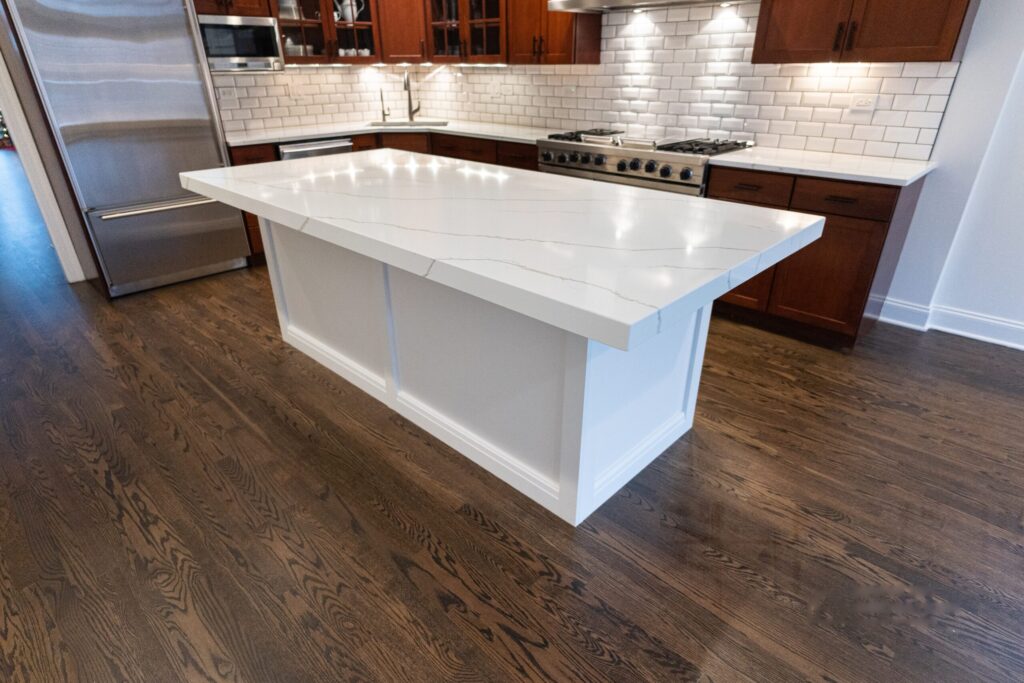
You just spilled red wine on the new island, or you are about to buy a slab and wonder what you are signing up for. Either way, the question is the same: what does it actually take to keep quartz kitchen countertops looking the way they did on installation day? The honest answer is less than most stone, but not nothing. Quartz forgives a lot of everyday abuse, yet it has a few weak spots, mainly heat, harsh chemicals and sunlight, that catch homeowners out. This guide covers how quartz is built, daily cleaning, what to avoid, how to handle stains, and how upkeep compares with granite, so you can protect the surface you paid for.
What Is Quartz, and Does It Need Sealing?
Engineered quartz is made from ground natural quartz bound together with resin and pigment, then pressed into slabs. It does not need sealing. Because the resin fills the space between the quartz particles, the surface is non-porous, and manufacturers say sealers, penetrants and topical treatments are unnecessary. One leading manufacturer’s care FAQ states that its quartz requires no sealing, polishing or reconditioning, and it describes the surface as nonabsorbent, which is why it resists stains.
That resin is also the reason for most of quartz’s limits. Resin handles daily life well, but it does not tolerate high heat, aggressive solvents or years of direct sun the way a solid piece of stone might. Keep that in mind and most of the rules below will make intuitive sense.
How Do You Clean Quartz Countertops Day to Day?
Warm water, a soft cloth and a drop of mild dish soap are enough for routine cleaning. Rinse, then dry with a clean cloth so the surface does not show water spots or soap film.

For dried-on food, soften it first. Lay a warm, damp cloth over the spot for a minute or two, then lift the residue with a plastic scraper or an old gift card held nearly flat. Do not dig at it with a knife or a metal putty blade.
What Should You Never Use on Quartz?
Avoid anything abrasive, strongly alkaline, strongly acidic or solvent based. Manufacturer care guides name bleach, oven cleaners, scouring powders and creams, abrasive scrub pads, paint removers and similar products, and they warn against applying sealers or polishes that can leave the finish dull and uneven. If a product’s label carries a hazard warning or tells you to use gloves and ventilation, it does not belong on your countertop.
Check with the maker if you want to try something not on its list. The correct reference is always the care guide for your specific product line, since brands differ slightly in what they approve.
Do and Don’t at a Glance
| Do | Don’t |
|---|---|
| Wipe spills promptly with a soft cloth | Let wine, coffee or oil sit overnight |
| Use warm water and mild dish soap | Use bleach, oven cleaner or paint remover |
| Place trivets or hot pads under hot cookware | Set a pan straight off the burner on the surface |
| Use a cutting board | Slice directly on the countertop |
| Dry the surface after cleaning | Scrub with abrasive pads or powders |
| Read your manufacturer’s care guide | Apply sealer, polish or wax unless the maker says to |
Stain First Aid for Common Kitchen Culprits
Most spills on quartz wipe away if you catch them, because liquid sits on top rather than soaking in. For anything that has set, work from gentle to firmer and stop as soon as the mark lifts.
| Stain type | First step | If it lingers |
|---|---|---|
| Red wine | Blot, then wash with warm soapy water | Repeat; check the care guide for an approved cleaner |
| Coffee or tea | Wipe with warm soapy water | Warm damp cloth held on the spot, then wash again |
| Cooking oil or grease | Dish soap and warm water | A second wash; a manufacturer-approved degreaser if needed |
| Permanent marker | Soap and water first | Ask the manufacturer which solvent, if any, is safe for your product |
| Dried food or sauce | Soften with a warm damp cloth, lift with a plastic scraper | Wash, rinse and dry |
| Hard-water film | Wipe with soapy water and dry | A cleaner your manufacturer lists as safe for the finish |
Can Quartz Take Heat From Pots and Pans?
Not reliably. Quartz is often described as heat resistant, but the manufacturer’s own guidance is more cautious: the care FAQ above says its quartz may not withstand direct heat from cookware and appliances such as electric frying pans, griddles, air fryers, slow cookers and roaster ovens. It recommends a closed-weave hot pad or a solid trivet, and it warns that sudden temperature changes, especially near edges, can cause damage.
In practice, resin can discolor, scorch, or even crack where concentrated heat meets the slab. A crack from thermal shock is usually not repairable in any way that looks invisible. Keep a trivet within arm’s reach of the stove.
This is also a design point. When you pick a backsplash and a range location, think about where the hot dishes will actually land. Our post on what works best when pairing kitchen countertops and backsplash walks through how the two surfaces work together.
Cutting Boards, Chips and Cracks
Quartz is hard, but “scratch resistant” is not “scratch proof.” The same manufacturer notes that cutting can leave marks, which show more on solid, monotone colors than on busy patterns, and that no stone surface is chip-proof. Use a board for cutting, which also keeps your knives sharp.
Chips most often happen at edges, particularly around the sink and dishwasher, when a heavy pot or a dropped cast-iron lid strikes a corner. A small chip can sometimes be filled by a professional stone fabricator with a color-matched repair. Cracks deserve a closer look, since they may point to heat stress, an unsupported span or a problem with the cabinet base beneath. Call your fabricator rather than gluing a crack yourself.
Sunlight, Seams and Edges
Direct sun can change some quartz colors. Resin and pigments can discolor under prolonged ultraviolet exposure, which is why many manufacturers and fabricators advise against using indoor quartz outdoors. Inside a Chicago kitchen, this usually matters only where a large south or west window throws strong light across the same stretch of counter every day, and it is more noticeable with certain colors. Ask your supplier whether the slab you like has any sun-exposure guidance, and if you have a bright window, a shade or blind during peak hours costs little.
Seams are where two slabs meet, and they are simply a fact of longer runs and L-shaped layouts. A well-made seam is tight and color-matched, but it is also a spot where grime can collect, so wipe along it with your regular cloth. Edges take the most abuse, so keep them clear of heavy impact.
Reading the Warranty Before You Need It
Every quartz brand writes its own warranty, and the terms differ. Read the care and maintenance guide that comes with your slab, and keep it with your closing or project documents. Look for what the manufacturer says counts as misuse, whether outdoor installation is covered, who must perform the installation for coverage to apply, and how claims are filed. Using an unapproved cleaner or setting a hot pan down can give a manufacturer grounds to deny a claim, so the care steps above aren’t just about appearance.
How Does Quartz Compare With Granite for Upkeep?
Quartz is generally the lower-maintenance of the two because it never needs sealing. Granite is natural stone and is more heat tolerant, but it needs more attention to its porosity. The Natural Stone Institute states that most granite countertops do not need to be sealed, though many benefit from a sealer that reduces moisture migration, so some owners choose to seal and others do not. The trade-off is that quartz asks you to protect the resin from heat and chemicals, while granite asks you to think about the sealer and porosity.
| Care question | Quartz | Granite |
|---|---|---|
| Sealing | Not needed | Often optional; follow your installer’s advice |
| Everyday cleaning | Mild soap and water | Mild soap and water |
| Heat | Use trivets; resin can discolor or crack | More heat tolerant, though trivets are still smart |
| Harsh chemicals | Avoid; can dull or damage the finish | Avoid acidic or harsh cleaners that can affect sealer |
| Sunlight | Some colors may discolor | Natural stone, generally not a color concern |
| Patterns | Uniform and consistent | Varies slab to slab |
If you are still deciding, our guide to quartz versus granite goes through appearance, durability and budget in more depth. And if you are curious about slimmer profiles, our Thinscape countertop page is a good place to start.
Planning Care Into a New Kitchen
Upkeep starts at design. In our Marshfield St. kitchen renovation in Lakeview, the cabinetry, countertops, tile and the plumbing and electrical behind them were rebuilt as one scope, and that kind of coordination is what lets you decide where trivet space, cutting zones and window light fall before anything is installed. See that project in our Lakeview kitchen gallery. In older Chicago buildings and condos, where kitchens are small, a dedicated spot for hot pans and a board is worth planning for.
Frequently Asked Questions
Do quartz countertops stain?
Rarely, because the surface is non-porous and liquids stay on top. Stains usually come from spills left to dry or from marker and harsh chemicals. Wipe quickly and use warm soapy water first.
Can I put a hot pan on quartz?
It is not recommended. Manufacturers recommend using a closed-weave hot pad or solid trivet because direct heat and sudden temperature changes can discolor the resin or cause cracking, especially near edges.
Can I use vinegar or bleach to clean quartz?
Stick to mild soap and water. Strong acids, alkaline products, bleach and oven cleaners are on manufacturers’ avoid lists. If you want something stronger, check the care guide for your brand first.
Does quartz fade in sunlight?
Some colors can discolor with prolonged direct ultraviolet exposure, because of the resin and pigments. Ordinary indoor light is rarely a problem, but a strong window beside one section of counter is worth shading.
Do I need to seal quartz like granite?
No. Quartz needs no sealing, and sealers can leave a dull or uneven finish. Granite is different; the Natural Stone Institute says most granite doesn’t require sealing, though some owners choose to.
Conclusion
Caring for quartz kitchen countertops comes down to a few habits: wipe spills early, clean with mild soap and water, use trivets and a cutting board, and read the manufacturer’s guide before trying anything stronger. Do that and quartz will stay one of the easier surfaces to live with. If you are planning a new kitchen or replacing worn counters, we would be glad to talk through materials, layout, and finishes with you. Take a look at our kitchen countertop and backsplash service, then tell us what your kitchen needs.